

Kodi SMB not working usually comes down to one of four things: the server refusing the login, Kodi and the server disagreeing on an SMB version, an empty browse list, or a wrong address.
This guide is written for Kodi 21 Omega or better, and it was last updated in November 2026. If you are on an older build, update Kodi first, because the menus below match the current release.
The short version:
- Skip browsing. Add the share with Add network location, using the server’s IP address, the shared folder name, and a username and password.
- Use a real account. Windows and many NAS devices now refuse guest logins, so give Kodi a dedicated local user with a password.
- Open Settings > Services > SMB client and set the Minimum protocol version to SMBv2 and the Maximum to SMBv3. Leave SMBv1 alone unless an old device forces it.
- If the Windows network list is empty, turn on Enable WS-Discovery Service in the same menu and make sure network discovery is on in Windows.
What Does Kodi SMB Not Working Mean?
Server Message Block (SMB), also called Windows File Sharing, is the protocol Windows uses to share folders over a local network. Other systems can use it too, which is why most NAS devices offer it. Kodi acts as the client: it connects to a shared folder on another device so you can scan and play the media stored there.
Kodi’s own wiki states that SMB v1 is not supported and that SMB v2 or higher must be used (Kodi wiki: SMB). Most failures come from that rule meeting a device or Windows setting that still behaves the old way, or from a login Kodi can’t complete.
Which Kodi SMB Error Do You Have?
Start with the message on screen. This table points to the fix that most often clears it.
| What you see | What it usually means | Try |
|---|---|---|
| Operation not permitted | Kodi and the server can’t agree on an SMB version, or the login is wrong. | Fix 2 and Fix 3 |
| Error 2: Share not available, or Connect timed out | Kodi can’t reach the device at the address you gave it. | Fix 1 and Fix 6 |
| Connection refused | The device answered, but it isn’t accepting SMB connections. File sharing may be off, or a firewall is blocking it. | Fix 6 |
| No route to host | A network problem between the two devices, such as a different subnet, a changed IP address or Wi-Fi isolation. | Fix 6 |
| Windows network (SMB) list is empty | Discovery is off, so Kodi can’t browse the network. | Fix 4 |
| Shares worked, then a password changed | Kodi is still sending the old login. | Fix 5 |
There are two ways to add a shared folder as a source. The folder needs read permission on the server, or read and write if Kodi needs to change files in it. If your share is not working, jump to the fixes below, because the second method is the one that survives most problems.
This is the simplest method when it works, because you browse instead of typing. It depends on WS-Discovery, which Kodi added in version 19.1 so that SMB browsing would work again after Windows dropped SMB v1.
- Go to Settings > File manager > Add source > Browse.
- In the Browse for new share window, choose Windows network (SMB).
- Open your server, then the shared folder you want, and select OK.
- Name the source and select OK to finish.
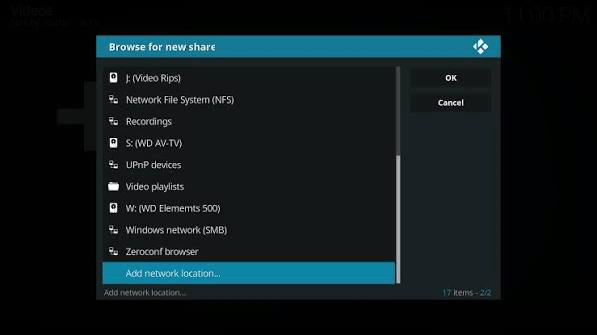
Use this method when the browse list is empty, or when you would rather type the address once and be done. Picture a share at \\DESKTOP\Media. The server is DESKTOP and the shared folder is Media.
- Go to Settings > File manager > Add source > Browse, then choose Add network location.
- Set Protocol to Windows network (SMB).
- In Server name, enter the device name or the IP address. If the device name fails, use the IP address.
- In Shared folder, enter the folder’s name. Per the Kodi wiki, the IP address method needs the drive letter in front (for example f/Movies), and the device name method does not.
- Enter the Username and Password you set up on the server. Kodi’s own how-to says to fill both in even when a share has no password, but a share with no password is the least reliable setup. See Fix 2.
- Select OK. The share now appears in the Browse for new share list, showing either the IP address or the device name, depending on which one you used.
If you use the IP address, reserve that address for the server in your router so it never changes. Log in to the router and add the device’s MAC address to its DHCP reservation list. Without a reservation, the router can hand the NAS a new address one day and Kodi will lose the share.
Both methods follow the steps in the Kodi wiki’s SMB page and the Kodi team’s SMB how-to.
Kodi SMB Not Working? 8 Fixes to Try in Order
Work through these from the top. Fixes 1 and 2 solve most cases.
If browsing fails, or a share added by device name never opens, remove it and add it again with Add network location using the server’s IP address. Type the username and password rather than leaving them empty. Without a login, the connection can be treated as a guest logon, and Windows rejects those (see Fix 2).
To find the IP address, check your router’s list of connected devices, or look at the network details on the PC or NAS itself.
Fix 2: Use a Dedicated Account, Not Guest Access
This is the change behind many failed shares. Starting with Windows 10 version 1709, SMB2 and SMB3 clients stop allowing guest logons by default on some editions, and Microsoft’s documentation says Windows 11 Pro builds block them too (Microsoft Learn). Windows 10 Home and Pro still allow guest access by default. A share open to Everyone with no password therefore works on some PCs and fails on others.
The Kodi team recommends password-protected shares and a separate local account that is used only for sharing. Do not reuse your normal Microsoft account, because that sends its password across your network. Here is the setup on a Windows PC:
- Open Settings > Accounts and go to the Other users page (some Windows versions call it Family & other users).
- Select Add someone else to this PC, then I don’t have this person’s sign-in information, then Add a user without a Microsoft account.
- Give the account a name and a password. Write them down, because Kodi needs both.
- Open Control Panel > Network and Sharing Center > Change advanced sharing settings. Turn on network discovery and file and printer sharing, and turn on password-protected sharing.
- Right-click the folder you want to share, choose Properties, open the Sharing tab and select Share.
- In the drop-down, pick the new account and select Add. Set the permission to Read, or Read/Write if Kodi has to change files, then select Share.
- Windows shows the network path for the folder. Keep it, because you enter its parts in Kodi.
- In Kodi, add the share (Fix 1) with that account’s username and password.
On a NAS, do the same thing in its admin page: create a user, give that user access to the share, and turn guest access off.
Microsoft does document a policy called Enable insecure guest logons, but it recommends against it, and it warns that guest logons are open to spoofed servers and ransomware (Microsoft Learn). A named account is the safer fix.
Fix 3: Set Kodi’s SMB Protocol Versions
Operation not permitted is often a version mismatch. Kodi lets you set the range it will negotiate:
- Go to Settings > Services > SMB client. If you can’t see the SMB client page, raise the settings level with the gear icon at the bottom left of the Settings screen to Advanced or Expert.
- Set Minimum protocol version to SMBv2.
- Set Maximum protocol version to SMBv3.
- Restart Kodi, then open the share again.
The Kodi wiki says forcing SMBv2 as the minimum may be needed on some systems to keep Kodi off SMBv1, and that SMBv1 is not recommended because of severe security vulnerabilities (Kodi wiki: SMB Client settings).
Two notes on older devices:
- Android and Android TV: a 2021 post from a Kodi team member says Android may need the Minimum set to SMBv1 and the Maximum to SMBv3 for the widest compatibility. Another Kodi developer has said that this combination ends up negotiating SMBv2 anyway. If SMBv2 as the minimum fails on an Android device, try that combination as a test, and put it back once you know whether it made a difference.
- Use legacy security: this switch forces weak SMBv1 security so Kodi can talk to the USB sharing feature on some Wi-Fi routers and NAS devices. Leave it off unless your device needs it. A better fix is to open the NAS settings and raise its own SMB range to SMB2 or SMB3, or update its firmware.
Fix 4: Fix an Empty Windows Network (SMB) List
An empty list means Kodi can’t discover your server. It does not mean the share is broken. Check these in order:
- In Kodi, open Settings > Services > SMB client and turn on Enable WS-Discovery Service. This is the setting that allows browsing of SMB network folders.
- On the Windows PC, open Advanced sharing settings and turn on network discovery and file and printer sharing. Set the network profile to Private.
- Check the Workgroup setting in the same Kodi menu. Most home networks use WORKGROUP.
- Leave WINS server blank unless your network actually runs a WINS server. If it does, enter that server’s IP address.
If the list is still empty, stop trying to browse and use Add network location (Fix 1). It does not depend on discovery.
Fix 5: Remove the Old Source and Add It Again
Kodi stores the login with each source. If you changed the password on the server, renamed the account or moved the share, Kodi keeps sending the old details and sees nothing. Kodi saves these in the passwords.xml and mediasources.xml files in its userdata folder.
The simple fix: go to Settings > File manager, right-click or long-press the source, remove it, and add it again with the current login.
Fix 6: Check the Network, Firewall and Port 445
Connection refused, No route to host and Share not available all point at the connection itself. These are general networking checks rather than Kodi settings:
- Make sure the Kodi device and the server are on the same network. A guest Wi-Fi network, or a router with AP isolation turned on, stops wireless devices from seeing each other.
- Confirm the server’s IP address has not changed. This is why Fix 1 recommends a router reservation.
- Check the firewall or antivirus on the server. SMB uses TCP port 445, and some security suites block file sharing from devices they don’t recognize. One Kodi forum user traced a Fire TV device being blocked to the network protection in their antivirus.
- Make sure file sharing is actually switched on, on the PC or NAS.
- Open the share from another computer. If that fails too, the problem is the server, not Kodi.
Fix 7: Stop Stuttering on Large Files Over SMB
If the share connects but 4K or high-bitrate files stutter, change the chunk size. Kodi 21 Omega added SMB chunk size to Settings > Services > SMB client. The default is 128 KB, and the options run from 16 KB up to 1 MB. The Kodi wiki says a different chunk size may help high-bitrate UHD playback on low-powered devices or slow networks (Kodi wiki: SMB Client settings). If stuttering continues, read our buffering guide, because a weak Wi-Fi link is the usual cause.
Fix 8: Read the Kodi Log
When nothing above helps, the log names the exact failure. Turn on debug logging in Settings > System > Logging, restart Kodi, try to open the share, then read the log or upload it for help. Our guide to checking Kodi log files shows where the file is and how to share it.
Possibly, but not always the way people assume. Microsoft says SMB signing is required by default on Windows 11 version 24H2 and Windows Server 2025, and that guest logons do not support signing or encryption, so the two do not mix (Microsoft Learn). Those changes hit Windows PCs connecting out to a NAS hardest. Kodi is not Windows, so they may not explain a Kodi failure on their own.
The pattern is still clear. Shares that depend on guest access are the shaky ones, and a named account with a password is the setup the Kodi team recommends. Fix 2 covers it.
Kodi SMB on Firestick and Android TV
Fire TV and Android TV devices have the same SMB menus as any other Kodi 21 Omega install. In practice, skip browsing and use Add network location with the server’s IP address and a real login, since those boxes have the least patience for discovery problems. If a share won’t connect on Android, the version note in Fix 3 applies to you. Our Kodi tips and tricks guide has more setup advice for these devices.
SMB vs NFS: Is NFS a Better Option for Kodi?
NFS is the other common way to share a folder with Kodi. The Kodi wiki says it moves data faster because it has less protocol overhead, and that it identifies users by a Unix user ID instead of a username and password (Kodi wiki: NFS). The trade-offs: it can be harder to set up, Windows cannot share folders over NFS on its own, and the wiki says to use it only inside a private home network because it is easier to attack.
A Kodi NFS path looks like nfs://1.2.3.4/path/to/folder, with a single slash between the server and the path. If your server is a Linux box or a NAS and SMB keeps failing, NFS is worth a try. If your server is a Windows PC, stay with SMB.
Kodi SMB FAQ
Go to Settings, File manager, Add source, Browse. Choose Windows network (SMB) to browse to the folder, or choose Add network location to type the server’s IP address, the shared folder name and a username and password.
Why is my Windows network (SMB) list empty in Kodi?
Kodi can’t discover your server. Turn on Enable WS-Discovery Service in Settings, Services, SMB client, and turn on network discovery in Windows. If the list stays empty, use Add network location with the server’s IP address instead, which doesn’t need discovery.
It usually means Kodi and the server can’t agree on an SMB version, or the login is wrong. Set the Minimum protocol version to SMBv2 and the Maximum to SMBv3 in the SMB client settings, then re-add the share with a real username and password.
Does Kodi support SMB v1?
Kodi’s wiki says SMB v1 is not supported and SMB v2 or higher must be used. The SMB client settings still include a legacy security option that forces weak SMBv1 behavior for some routers and NAS devices. Treat it as a last resort because SMBv1 has serious security problems.
Kodi’s team recommends password-protected shares. Windows blocks guest logons by default on some editions, so a share with no password may work on one PC and fail on another. Create a dedicated local account for sharing and use it in Kodi.
Which is better for Kodi, SMB or NFS?
SMB is the better choice for a Windows PC and the most common choice for a NAS. According to the Kodi wiki, NFS is faster and uses no passwords, but it is harder to set up, Windows can’t share over it natively, and it should stay on a private network.
Still stuck? Work through our Kodi not working guide, or see Kodi keeps crashing or freezing if the app itself is unstable.
Sources: Kodi wiki, SMB; Kodi wiki, SMB Client settings; Kodi wiki, NFS; Kodi forum, SMB how-to; Microsoft Learn, insecure guest logons. Updated November 2026 for Kodi 21 Omega or better.
If you are an avid Kodi streamer, you might want to check out the Best Kodi tips.